Today was the Boston OpenClaw Hackathon, which had a theme of using the Boston open data hub.
For my project, I wanted to see how far OpenClaw could get on its own in analyzing the data (with Claude Sonnet 4.6 as a backing model).
First, I had OpenClaw connect itself to the MCP server, starting from the press release about the launch of the MCP server.
Once connected, I asked it to analyze contracts for signs of corruption. It was able to come up with its own approach for signals and queries. For example: "Departments Using the Most Limited Competition", "Top Vendors by Limited Competition Value", and "Bid Threshold Clustering (near $10K)".
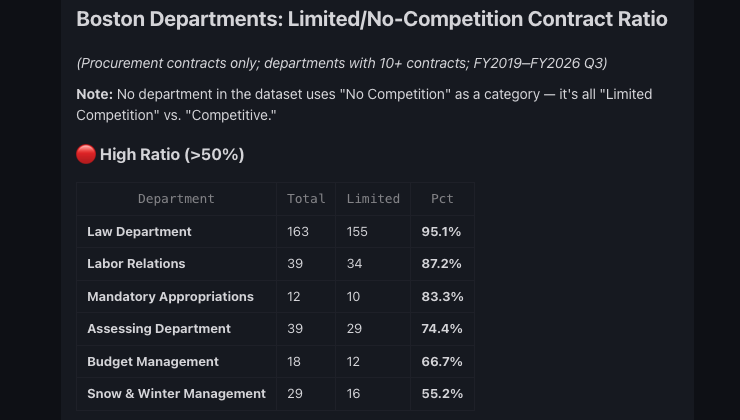
After flagging companies, I had it analyze those companies' connections to city officials.
There were some interesting nuggets! For example, Capitol Waste Services was flagged as high risk for having $285M in historic contracts, of which $136M were awarded with limited competition.
The connection research flagged a 2015 fine of $120,000 by the Office of Campaign and Political Financing (OCPF) for illegal campaign donations.
From there, I had OpenClaw create and package a skill for flagging corruption signals. The skill encodes the queries and data analysis scripts it developed. That skill is available here: boston-contract-corruption.skill.
Some other interesting questions OpenClaw was able to answer from the data:
- Which restaurants are the worst health code offenders but haven't been shut down yet?
- Which roads/intersections are the worst for biking, based on pothole reports and accidents?
Overall, it was a fun experiment to see how AI agents might impact civic tech. A big thanks to the hackathon organizers, everyone who demoed, and the city of Boston for making this data available!